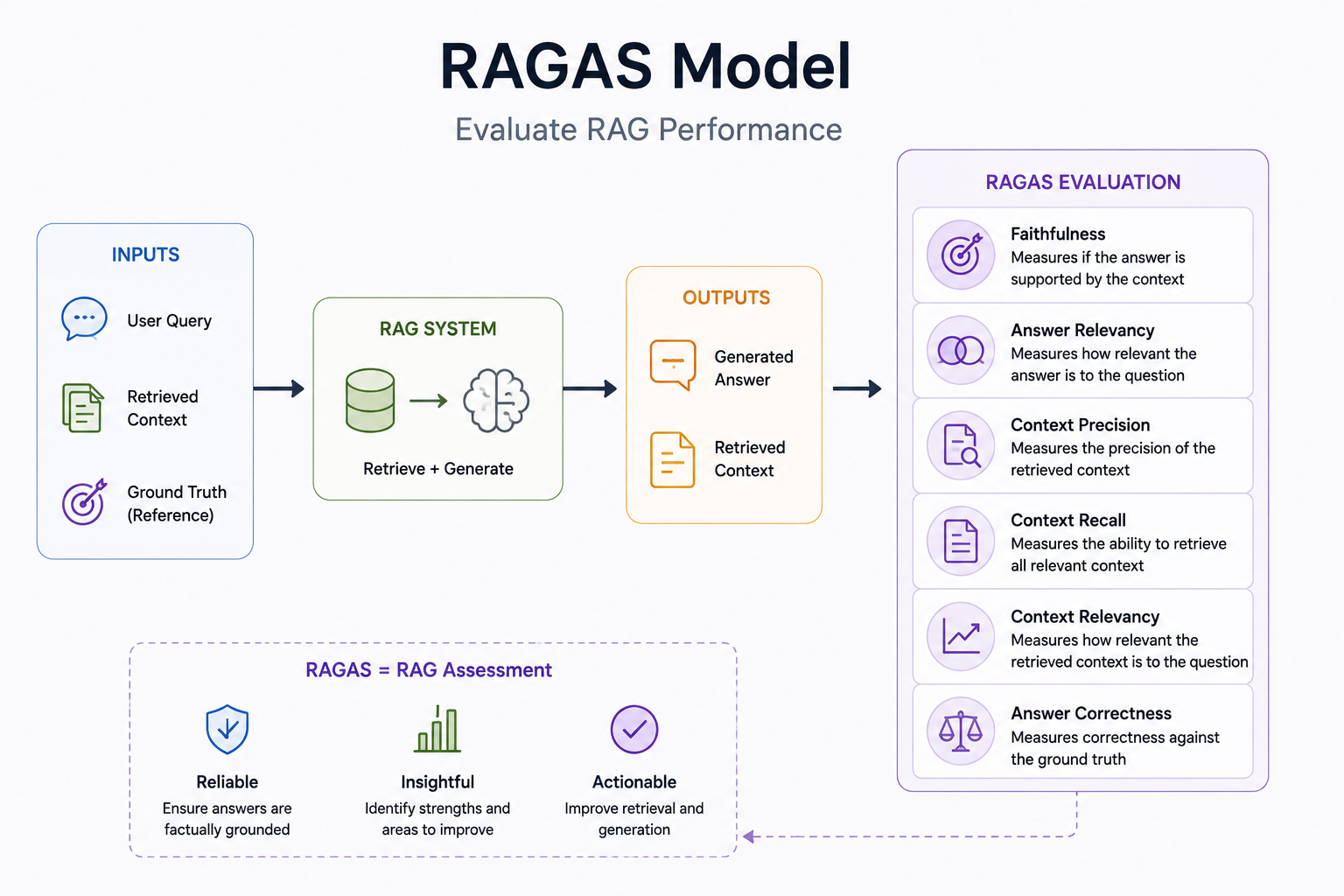
After you build a RAG pipeline ([Basic RAG]({% post_url 2025-04-26-BasicRAG %}), [Fusion Retrieval]({% post_url 2025-05-10-FusionRetrieval %}), [Multi-Modal RAG]({% post_url 2025-06-17-MultiModalRAG %}), or [GraphRAG]({% post_url 2025-08-27-GraphRAG %})), a natural question is: how good is it?
RAGAS (Retrieval Augmented Generation Assessment) evaluates RAG outputs with an LLM as the judge. You provide questions, predicted answers, ground-truth answers, and retrieved contexts; RAGAS returns scores from 0 to 1.
Core metrics
Metric
What it measures
Score range
Answer Correctness
Is the answer factually correct vs. the ground truth?
0 to 1
Faithfulness
Is the answer grounded in the retrieved context (no hallucination)?
0 to 1
Context Precision
Are retrieved chunks relevant and well-ranked?
0 to 1
Models used
LLM judge:gemma3:4b via [Ollama]({% post_url 2024-01-15-ollama %}) (local)
Embeddings:mxbai-embed-large:335m via Ollama (local)
Everything runs locally — no OpenAI API key required.
Step by Step Coding guide
Pull models: ollama pull gemma3:4b and ollama pull mxbai-embed-large:335m.
Install helpers such as ragas, datasets, langchain-ollama.
RAGAS uses an LLM to judge answer quality and an embedding model for semantic similarity in some metrics.
Wrap Ollama models with RAGAS-compatible wrappers.
ollama_llm = LangchainLLMWrapper(ChatOllama(model="gemma3:4b"))embedding_model = LangchainEmbeddingsWrapper( OllamaEmbeddings(model="mxbai-embed-large:335m"))print("LLM judge and embedding model ready")
Step 2: Test answer correctness
Answer Correctness checks whether the predicted answer matches the ground truth.
It combines:
Factual similarity — same facts? (LLM judge)
Semantic similarity — similar meaning? (embeddings)
Example: ground truth is "Madrid is the capital of Spain." and the prediction is only "MadriD." — brief, but still correct.
eval_dataset = Dataset.from_dict({ "question": ["What is the capital of Spain?"], "answer": ["MadriD."], "ground_truth": ["Madrid is the capital of Spain."], "contexts": [["The capital of Spain is Madrid."]],})result = evaluate( dataset=eval_dataset, metrics=[answer_correctness], llm=ollama_llm, embeddings=embedding_model,)print(result)print(result.to_pandas())
Expect a score close to 1.0: "MadriD" is factually right even if it is not a full sentence.
Step 3: Test faithfulness
Faithfulness asks: is the answer grounded in the retrieved context (no hallucination)?
RAGAS roughly:
Breaks the answer into factual claims
Checks whether each claim can be inferred from the context
faithfulness ≈ (claims supported by context) / (total claims)
Here the answer is "6" and the context says "3+3=6" — fully grounded, so expect 1.0.
Context Precision measures whether retrieved chunks are relevant and ranked well.
Relevant chunk first → high precision; irrelevant chunks above it → lower precision.
Simulated retrieval with 3 chunks (relevant one last):
"this is a test context" — irrelevant
"mike is a cat" — irrelevant
"if the shoes don't fit, then go somewhere else." — relevant
Expect precision around ~0.33.
eval_dataset = Dataset.from_dict({ "question": ["What if these shoes don't fit?"], "answer": ["if the shoes don't fit, then go somewhere else."], "ground_truth": ["then go somewhere else."], "contexts": [[ "this is a test context", "mike is a cat", "if the shoes don't fit, then go somewhere else.", ]],})result = evaluate( dataset=eval_dataset, metrics=[context_precision], llm=ollama_llm, embeddings=embedding_model,)print(result)print(result.to_pandas())
Step 5: Evaluate multiple questions with all metrics
In practice, score many questions and several metrics in one call.
Important: "contexts" must be a list of lists — one list of chunks per question.
eval_dataset = Dataset.from_dict({ "question": ["What is the capital of Spain?", "What is 3+3"], "answer": ["Madrid is the capital of Spain.", "6"], "ground_truth": ["MadriD.", "6"], "contexts": [ ["The capital of Spain is Madrid."], # question 1 ["3+3=6"], # question 2 ],})result = evaluate( dataset=eval_dataset, metrics=[answer_correctness, faithfulness, context_precision], llm=ollama_llm, embeddings=embedding_model,)print("\nAggregate scores:")print(result)
Step 6: View per-question results
Aggregate scores are averages. Inspect the row-level breakdown with pandas.
Even "MadriD." can score high vs. a full ground truth
Answer fully grounded in context
Faithfulness
Score = 1.0 when every claim comes from the context
Irrelevant chunks ranked above relevant ones
Context Precision
Score drops when the retriever ranks poorly
Multiple questions + all metrics
All three
RAGAS can evaluate everything in one call
Tip: build a small labeled set (question, ground truth, your RAG’s answer + contexts), run RAGAS after each pipeline change, and track which metric moves — that tells you whether to fix retrieval, prompting, or hallucination.