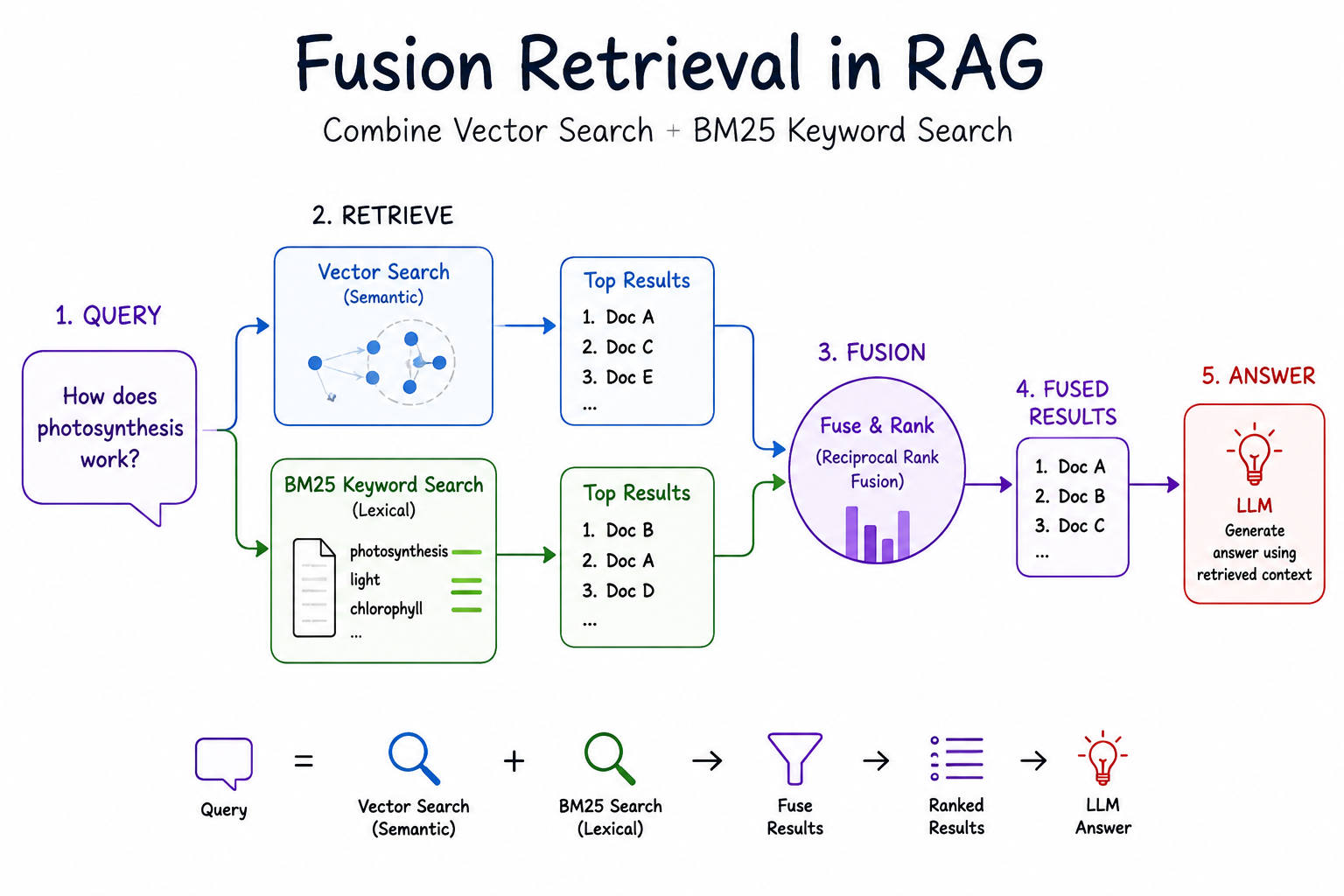
In the [Basic RAG post]({% post_url 2025-04-26-BasicRAG %}), retrieval relied on vector search: find chunks whose embeddings are close to the question.
Vector search is strong at meaning (synonyms, paraphrases), but it can miss exact keywords (for example a chemical formula, an ID, or a rare acronym).
BM25 is a classic keyword ranker: great at exact terms, weak on semantics.
Fusion retrieval runs both, normalizes their scores, and blends them so you get meaning and keywords.
BM25 (Best Matching 25) scores a chunk by how often query terms appear, adjusted for document length.
Build it from the same chunks used in the vector store so both methods rank the same candidate set.
tokenized_docs = [chunk.page_content.split() for chunk in chunks]bm25 = BM25Okapi(tokenized_docs)print(f"BM25 index created from {len(tokenized_docs)} chunks")
Step 4: Perform fusion retrieval
Core steps:
Score all chunks with BM25
Score all chunks with vector similarity
Normalize both to [0, 1] (invert vector distance so higher = better)
Combine with alpha
Sort and keep top-k
query = "What are the impacts of climate change on the environment?"k = 5alpha = 0.5 # 0.5 = equal weight to vector and BM25epsilon = 1e-8 # avoid division by zeroprint(f"Query: {query}")print(f"alpha = {alpha} (0 = pure BM25, 1 = pure vector, 0.5 = equal)\n")# A) All documents in index orderall_docs = vectorstore.similarity_search("", k=vectorstore.index.ntotal)# B) BM25 scoresbm25_scores = bm25.get_scores(query.split())print(f"BM25 scores range: [{bm25_scores.min():.4f}, {bm25_scores.max():.4f}]")# C) Vector similarity scores (FAISS distance: lower is better)vector_results = vectorstore.similarity_search_with_score(query, k=len(all_docs))vector_scores = np.array([score for _, score in vector_results])print(f"Vector scores range: [{vector_scores.min():.4f}, {vector_scores.max():.4f}]")# D) Normalize to [0, 1]vector_scores = 1 - (vector_scores - vector_scores.min()) / ( vector_scores.max() - vector_scores.min() + epsilon)bm25_scores = (bm25_scores - bm25_scores.min()) / ( bm25_scores.max() - bm25_scores.min() + epsilon)print(f"\nNormalized vector scores range: [{vector_scores.min():.4f}, {vector_scores.max():.4f}]")print(f"Normalized BM25 scores range: [{bm25_scores.min():.4f}, {bm25_scores.max():.4f}]")# E) Combinecombined_scores = alpha * vector_scores + (1 - alpha) * bm25_scores# F) Rank and take top-ksorted_indices = np.argsort(combined_scores)[::-1]top_docs = [all_docs[i] for i in sorted_indices[:k]]print(f"\nTop {k} combined scores: {[f'{combined_scores[i]:.4f}' for i in sorted_indices[:k]]}")
Step 5: Display the retrieved documents
for i, doc in enumerate(top_docs):
    print(f"Result {i}:")
    print(f"Content: {doc.page_content[:300]}...")
    print(f"Source: page {doc.metadata.get('page', 'N/A')}")
    print("=" * 80)
Step 6 (optional): Compare different alpha values
See how the top hit shifts when you favor BM25 vs vector search.
for test_alpha in [0.0, 0.25, 0.5, 0.75, 1.0]:
    scores = test_alpha * vector_scores + (1 - test_alpha) * bm25_scores
    best_idx = np.argmax(scores)
    print(
        f'alpha={test_alpha:.2f}: top result = "{all_docs[best_idx].page_content[:80]}..."'
    )
Summary
Fusion retrieval = vector search + BM25, score-normalized and blended with alpha.
It can catch documents that either method alone might miss. A query like “CO2 emissions impact” benefits from BM25 (exact term CO2) and vector search (semantic “impact” ≈ consequences).
Tune alpha per use case: more keywords → lower alpha; more paraphrases → higher alpha.
Next: plug top_docs into the Generate step from [Basic RAG]({% post_url 2025-04-26-BasicRAG %}), or explore graph expansion in [GraphRAG]({% post_url 2025-08-27-GraphRAG %}).